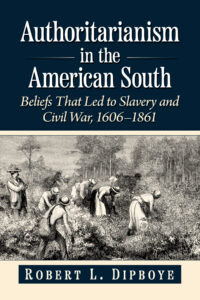
I am pleased to announce the publication of Authoritarianism in the American South: Beliefs That Led to Slavery and Civil War. In keeping with the theme of this blog, I explore the causes of the American Civil War through the lens of social psychological research on authoritarianism. The primary thesis is that an authoritarian belief system shaped the slave society of the pre-Civil War American South.
Using statements from southern elites in the colonial and antebellum periods, as well as findings from contemporary psychological research, I describe four themes: a belief in a dangerous/competitive world, a dominance/obedience orientation, us vs them mentality, and closed-mindedness. The belief system of the founding elites, in combination with the travails they experienced in the southern frontiers, led to a slave society that protected their wealth, power, and status from real and imagined threats. It also motivated total and oppressive attempts to dominate, spawned racist justifications, and corrupted thinking, emotion, and behavior. Despite changes in content, the four themes remain deeply rooted and continue to inhibit economic and social progress in the South.
Chapter outlines:
Chapter I: Why Did William Cross Fight?
The opening chapter asks why the Civil War occurred. I discuss three key points in detail: (1) the planter elites were prime movers, (2) slavery was the professed reason for secession, and (3) an authoritarian belief system was the root cause.
Chapter 2: Making the Authoritarian Slave Society
The antebellum South was more than a slave society; it was an authoritarian slave society. There were three origins of this authoritarianism. First, the founding elites brought with them authoritarian beliefs from Britain. Second, the economic context and agricultural demands of 17th and 18th century British colonial America produced authoritarian beliefs. Third, and most important, the authoritarianism of the elites helped them cope with the unique threats facing the southern colonies.
Chapter 3: Justifying the Authoritarian Slave Society
The elite enslavers had an iron grip on the South, but their power was never enough to allay their insecurity. They felt compelled to justify their way of life, and the defense of slavery was central to these justifications. But it is important to recognize that the elite were defending not only the institution of slavery but also the authoritarian society that supported and nurtured the practice.
Chapter 4: Corrupting the Southern Elite
The authoritarianism of the colonial and antebellum South corrupted the thinking, emotion, and action of the elite enslavers. Southern elites succeeded through executive, legislative, and judicial actions at the state and Federal levels in defending slavery during the first eight decades of the republic. Nevertheless, they became increasingly insecure and fanatical in response to criticisms of authoritarian slave society. The corruption of thinking, emotion, and action spilled over into the political decisions of southern Democrats and led to secession.
Epilogue: The Legacies of Antebellum Authoritarianism
Although the Civil War may have ended slavery, the authoritarian belief system that was foundational to the slave society persisted in a modified form and continues to shape the South.
For more information, check out:
https://www.barnesandnoble.com/
Menu: